

The Wit’s Guide to Tsundoku
Or, pro anti libraries
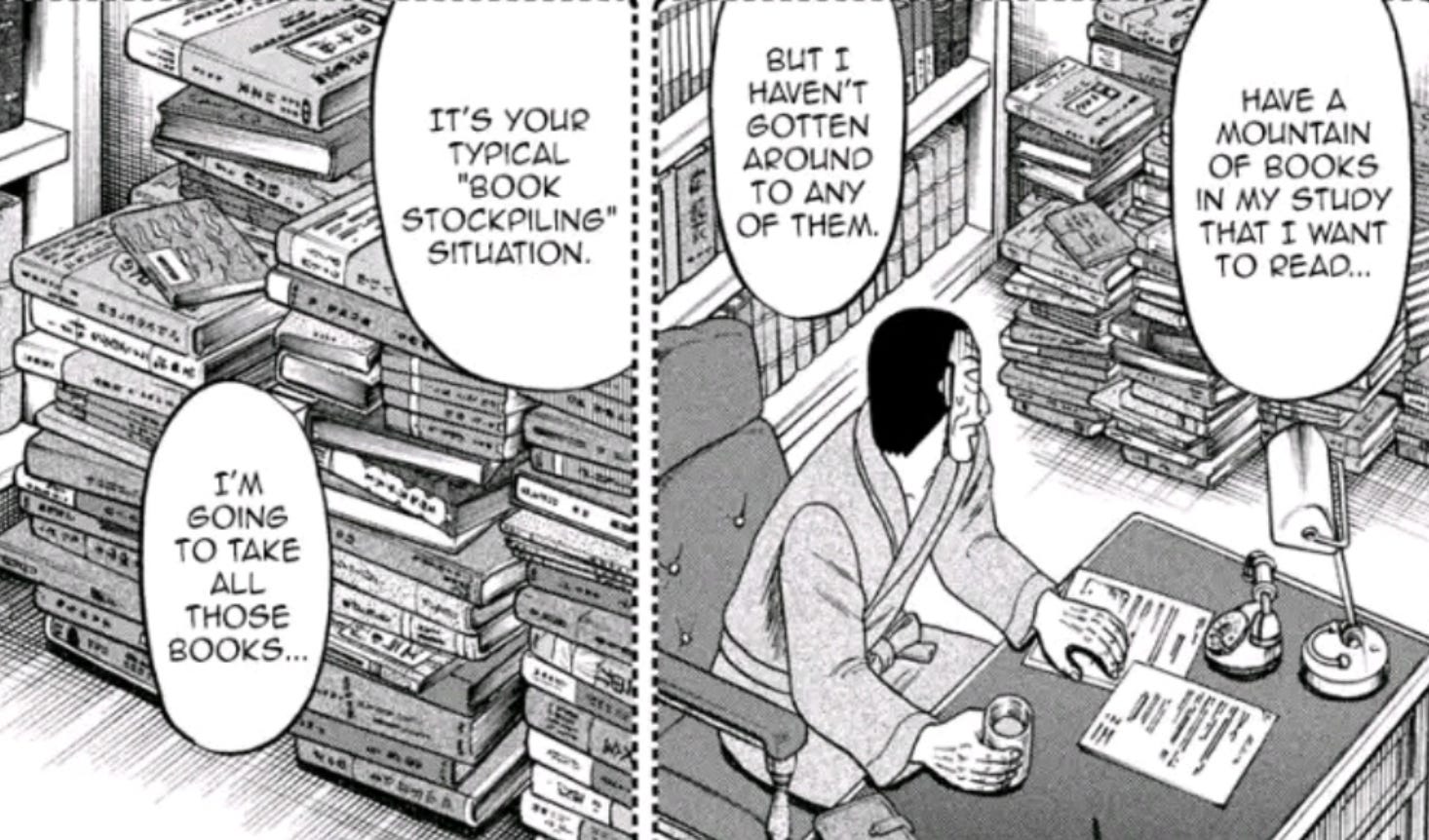
When the Grim Reaper comes a-knocking, the first question on his liplessness will be: How many books do you have left to read? If the number you offer is high enough (and if you remembered to leave out carrots for his reindeer), he’ll leave you be and go on his morbid way.
“The buying of more books than one can read is nothing less than the soul reaching toward infinity.”
— A. Edward Newton
This is false — I think, I’ll report back later — but it’s the subconscious justification for tsundoku. I’d like to say that this Japanese word for the tendency to buy books you never get around to reading comes from the same root as tsunami, bringing to mind an encroaching ocean of erudition, but my Japanese is too rusty to make such a claim. As far as I can tell, it’s from tsumu, meaning to pile up, and doku, meaning reading.
“The truly cultured are capable of owning thousands of unread books without losing their composure or their desire for more.”
— Gabriel Zaid
The great thing about tsundoku is that it’s apparently not a judgmental term. They haven’t added it to the Japanese version of the DSM and you can’t be prescribed peptides for it. The closest English translation, bibliomania, has been pathologized as a subset of hoarding, which in turn falls under obsessive-compulsive behaviour, which is then grouped under the larger category of totally missing the point.
“A man loses contact with reality if he is not surrounded by his books.”
— Francois Mitterrand
One question worth asking: Do you hoard other things? Is having more clothes than you can ever wear, more food than you can ever eat, or more houses than you can ever occupy a similar condition? Having more books than you can ever read is aspirational in a different way. Would you be a different person if you finally sailed in every yacht you owned? That reminds me that I’ve happily tsundokued the wonderfully titled Evan Osnos book The Haves and the Have-Yachts: Dispatches on the Ultrarich.
“The thing about books is, there are quite a number you don’t have to read.”
— Donald Barthelme
It’s bad form to read a book called How to Talk About Books You Haven’t Read, but a quick scan of said book reveals the parable of Musil’s Librarian. In the modernist novel A Man Without Qualities by Robert Musil, the character in question explains that the “secret of a good librarian is that he never reads anything more of the literature in his charge than the title and the table of contents.” He doesn’t dare dig deeper. The love of all books, equally like children, forbids him from giving any one volume preferential treatment.
“Some books are undeservedly forgotten; none are undeservedly remembered.”
— W.H. Auden
In Nassim Nicolas Taleb’s The Black Swan — another book I haven’t read, this one probably because of the irritatingly precise jacket blurb that calls it “The most influential book of the past seventy-five years” — there is the story of Umberto Eco’s 30,000 book library and the idea that anyone who asked if he’d read them all just didn’t get it. “Read books are far less valuable than unread books,” Taleb writes, and then suggests that your collection of unread books be called your antilibrary.
“A library is thought in cold storage.”
— Herbert Samuel
And herein lies the solution for tsundoku: After removing atlases, dictionaries, almanacs, yearbooks, Stephen Hawking’s A Brief History of Time, and all other books that aren’t actually meant to be read, add the sum total of your library to your antilibrary. This is the actual number of books that you own. Isn’t that a relief? Just ensure that your library and your antilibrary never come into contact, obliterating all useful knowledge and thus forcing you to start watching Summer House.
“The book collector’s caveat: Never lend a book; never give a book away; never read a book.”
— John Sparrow

“It is one of the misfortunes of life that one must read thousands of books only to discover that one need not have read them.”
— Thomas de Quincey
The concept of the antilibrary reminded me of Anti-Garry Gum from the classic British educational parody series Look Around You. Write that down in your copy book now. Next week?

Each month my paid subscribers and I exchange some of the best things we’ve read, seen, heard, and experienced in a special issue called Get Wit Picks. I just finished and enjoyed Ben Lerner’s Transcription, which is fundamentally about our phones and what they’ve done to us, but not at all in the preachy annoying way that sounds. I wouldn’t call it witty at the sentence level, but here are two highlights:
“I wondered if Thomas’s name and number would show up on her phone or if it would say ‘Spam Risk’ or ‘Unknown Caller,’ a phrase that sounded Victorian to me.”
“I was glitching, craving my cellular phone on a cellular level, shamefully unresponsive to the old media that surrounded me: books, paintings, analog photographs, a vinyl record spinning somewhere in my mentor’s house.”

Get Wit Quick No. 372 briefly considered Marie Kondo’s apocryphal suggestion to max out your library at 30 books, looked it in the eye, decided it did not spark joy, and thanked it for its service before taking it out behind the shed with the captive bolt pistol Javier Bardem used in No Country for Old Men. The mascot is Magnus the magpie, who had to be a magpie with a name like that. The title font is Vulf Sans, the official typeface of the band Vulfpeck. The inferior-for-now and still free AI replicant is at getwitquicker.replit.app. The book was Elements of Wit: Mastering The Art of Being Interesting, and you ought to own a whole pile of them. If you have or haven’t read it, let me know by tapping the ❤️ below.
Thank you to everyone who voted for this topic. And I must say this quote from you is really one of my favorites ever. "The closest English translation, bibliomania, has been pathologized as a subset of hoarding, which in turn falls under obsessive-compulsive behaviour, which is then grouped under the larger category of totally missing the point."
Good grief, I still haven't finished the Old Testament.