

The Wit’s Guide to Neighbours
Or, the people vexed door
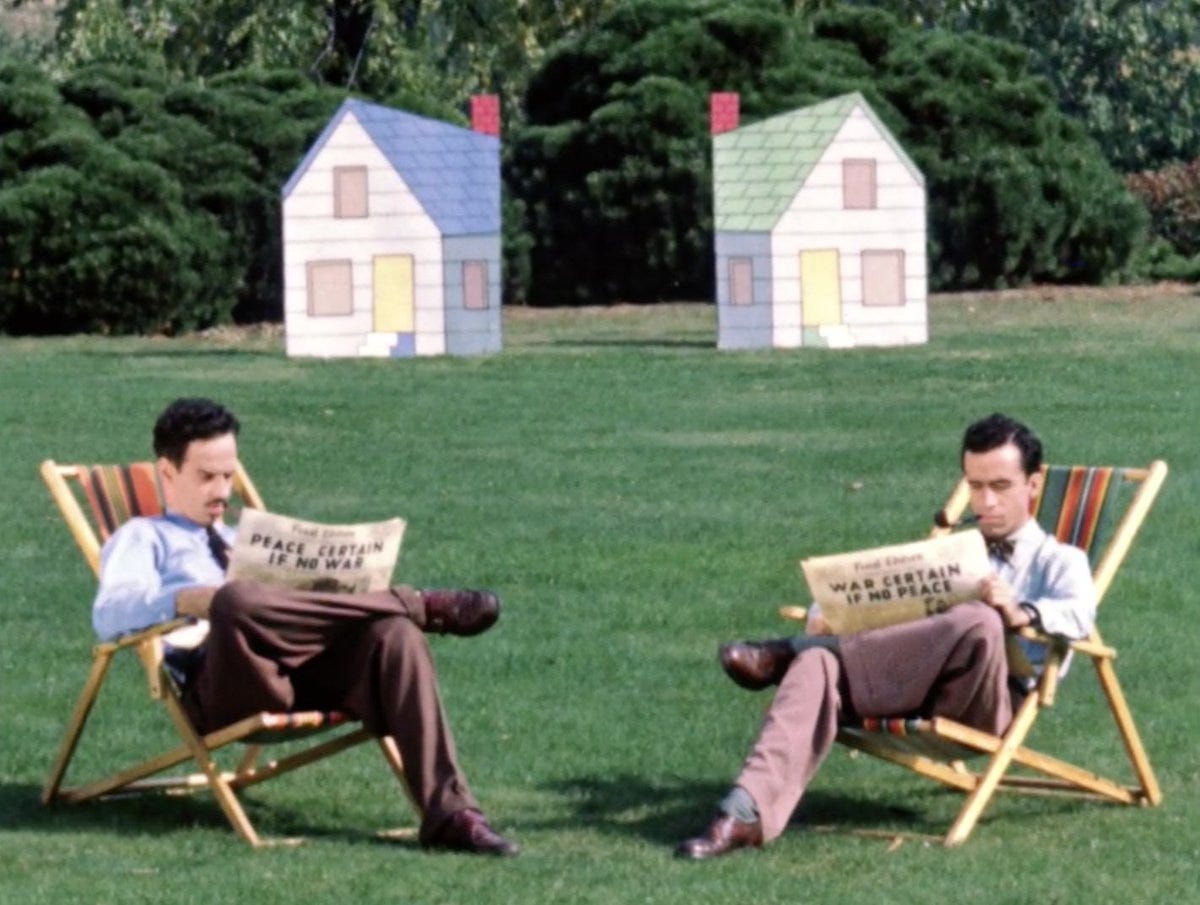
It’s a funny thing when your neighbour discovers neighbourliness. The neighbour, I write with a conspicuous U from Canada, is the United States, and the discovery is bubbling up from all corners. Here’s Adam Serwer in The Atlantic: “If the Minnesota resistance has an overarching ideology, you could call it ‘neighborism,’ a commitment to protecting the people around you, no matter who they are or where they came from.”
“We are commanded to love our neighbor because our ‘natural’ attitude toward the ‘other’ is one of either indifference or hostility.”
— W.H. Auden
“When you cut through all the idiot chatter of these topsy-turvy modern times, what is the underlying secret to true swag?” ask the authors of Blackbird Spyplane, the densely jargoned style ’stack. You might think it’s really, really big pants, but no. They say they’d be “hard pressed to give you a better, more eternally resonant, and more concise answer than neighborliness.” Yes, “leaving your home and being kind, helpful & chill to others” is their underlying principle of Mach 3+ decor. It’s not the message you’d expect in a guide to expensive ceramics but it’s welcome all the same.
“The Bible tells us to love our neighbors, and also to love our enemies; probably because they are generally the same people.”
— G.K. Chesterton
For those of us blessed to not be under siege, how does one practice good neighbourism? Step One is to master the friendly wave, a simple acknowledgment of the person you see on a regular basis, even if the name escapes you. In his Book of Delights, the poet Ross Gay lists The Wave of Unfamiliars as Delight No. 73, specifically citing his Minnesotan grampa as the tidal waver. “To the driver of every passing truck or car he raised his first two fingers to the stiff brim of his John Deere ball cap and cut them through the air like the gentlest initiation of a curve ball ever,” Gay writes. “It was an elegant wave, understated, that intimated an older time of hat-tipping and such.”
“Do not love your neighbour as yourself. If you are on good terms with yourself it is an impertinence; if on bad, an injury.”
— George Bernard Shaw
Step Two is tapping the emergency bakes. “Lend me some sugar,” Andre 3000 implores in Hey Ya!, for “I am your neighbor.” He was talking about sex, but let’s take him at his word. In most urban areas you can get instant delivery of granulated sucrose in exchange for money plus delivery fee, services fee, tax, and tip via a tech platform. But there’s something better about borrowing from a neighbour, not least because you’ll owe them something in return, perhaps a few slices of the banana bread that got you into this sugar-needing situation. When anthropologist Laura Bohannan visited a Tiv village in central Nigeria, she was presented with “two ears corn, one vegetable marrow, one chicken, five tomatoes, one handful peanuts.” The expectation, she learned, was that after some period of time she had to roughly return the favour. Not by replaying the exact value of goods, as that would rudely signal the end of the exchange, but rather by returning a bit more or a bit less to knit neighbours together. The result was “endless circle of gifts in which no one ever handed over the precise value of the object last received but in which, over months, the total exchange was never much more than a penny in anyone’s favor.”
“There are many who dare not kill themselves for fear of what the neighbours will say.”
— Cyril Connolly
And finally, Step Three is to give your neighbours space. “The best neighbour is the neighbour who leaves you alone unless asked for help,” wrote Auberon Waugh in 1994, “not the neighbour who is forever ringing the doorbell to ask if you are all right, and the council tenants of Stonebridge Park Estate are a shining example to us all.” He was responding to a news report of an elderly man who’d died in his apartment and wasn’t discovered for four years. The standard take was that this was a grim sign of social alienation, but Waugh differed. “I think it is greatly to modern society’s credit that he lay undisturbed by the local welfare busybodies for all that time, or even by convivial neighbours. Through three Christmas seasons, while the police were out trying to terrorise motorists, and the nation’s 5.2 million public employees were otherwise occupied, his corpse quietly recycled itself with the kitchen linoleum.” It’s perhaps extreme to prefer a cold body to a busybody, but it’s also undeniable that nothing kills neighbourly vibes like a buttinsky.
“But how little we know what would make paradise for our neighbours! We judge from our own desires, and our neighbors themselves are not always open enough even to throw out a hint of theirs.”
— George Eliot
If your neighbour becomes your friend, it matters more that they’re your pal. If your neighbour becomes your enemy, it matters more that they’re your neighbour. In all other situations, wave hello, borrow the occasional egg, and leave them be. Caveat if you’re American: Alert them when the secret police are coming and keep your phone handy. Caveat if you’re America: Focus on the “leave them be” part.

“Ask your neighbour only about things you know better. His advice might prove valuable.”
— Karl Kraus
Canada also shares a land border with Denmark, thanks to the peaceful resolution of the Whisky War in 2022. Technically the Danes brought schnapps to a whisky fight, but these are precisely the sort of differences you need to overlook if you want to be a good neighbour. And for next week?

Do you ever look at yourself in the mirror and wonder, who am I? Good news: You’re the kind of person who reads Get Wit Quick. And what kind of person is that? You self-identify as:
People like me.
People like me who are interested in wit but not sufficiently motivated to undertake a PhD in the damn stuff.
People like me, whose favorite part of any magazine was always the last page. Not because it was the last, but because it’s the one where fun and personality was allowed, no matter how serious the rest of the pages.
An intelligent person wanting an intelligent diversion.
Anyone with a sense of humour (so not members of the Conservative Party).
Thoughtful people.
people who love words, people who host dinner parties.
Curious and idle people.
Lovers of language.
People who liked to learn what others think about things.
People who like to see something a bit out of left field that is clever, thoughtful and amusing.
My kind of people! And how can I deliver more value, joy, elan, and/or zip to these people? The most requested subscriber perk was “a place for readers to share great quotes they’ve come across,” and next week I’ll lift the velvet rope on exactly such a location. Special commendation to the reader who asked that their perquisite be delivered in the form of “a glass of single malt.”

Get Wit Quick No. 356 is happy to shovel the walks of the emails on either side of this one in your inbox. This newsletter’s mascot is a magpie named Magnus after the magician in Robertson Davies’ Deptford Trilogy. The title font is Vulf Sans, the official typeface of the band Vulfpeck. The inferior-for-now AI replicant is at getwitquicker.replit.app. The book was Elements of Wit: Mastering The Art of Being Interesting. Give the ❤️ below an elegant wave.
Dear Benjamin,
Thank you as always for all of this.
One of my favorite quotes from this week:
“Ask your neighbour only about things you know better. His advice might prove valuable.”
— Karl Kraus
Thank you for sharing!
Love
Myq
As one of those neighbors down south of the border, I really did appreciate this particular piece. Thanks!