

The Wit’s Guide To Oil
Or, dinosaur juice from hell
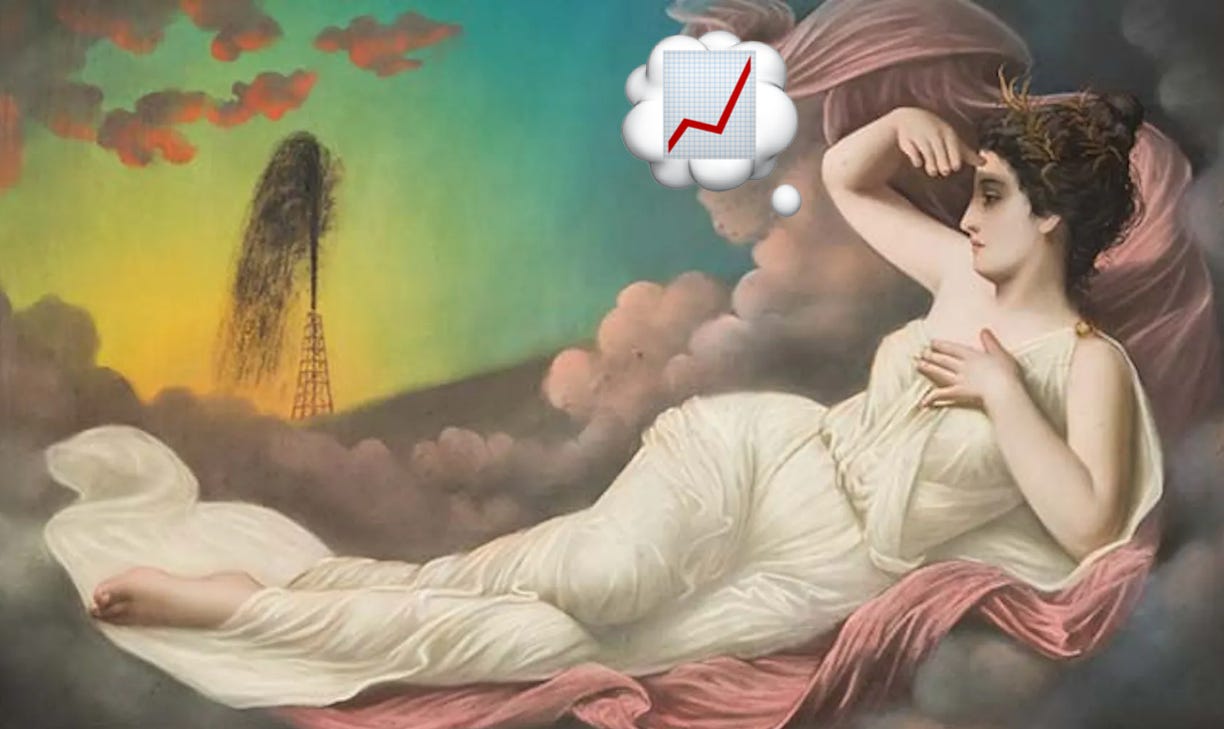
If you’ve ever wondered why kids are so obsessed with dinosaurs, take a look in the mirror. Wait! I am not suggesting you, dear reader, are a dinosaur, but rather that our entire civilization is besotted with the terrible lizards who were long ago compressed into the liquid energy we call light sweet crude. Our whole world runs on dinosaur juice! The little ones are just teaching themselves modernity’s backstory. And extra credit if they use plastic toys to do so!
“Dear future generations: Please accept our apologies. We were roaring drunk on petroleum.”
— Kurt Vonnegut
Was it, in retrospect, a good idea to base all human activity on the burning of earth-bound hydrocarbons? You already know the answer to that question and likely try not to think about it. But let me offer this edge case, ideal for the marketing campaigns of the Pathways Alliance: It was once thought that petroleum saved the whales! Before we figured out how to get oil out of the ground, humans devised a way to take rickety wooden ships from Massachusetts into the middle of the Pacific, board even smaller, ricketier vessels, stab the largest mammals on the planet in the head, and scoop out all the foul-smelling substances therein. This, for a surprisingly long stretch of our history, was just something we did. And in the mid 1800s, when we discovered how to get oil out of the ground, it was estimated that the global whale population was about a decade away from extinction.
“If you haven’t struck oil in your first three minutes, stop boring!”
— George Jessel
Once we powered our boats with oil, we could really go after those whales, and that’s actually when we pushed them to the brink. So no, petroleum didn’t save the whales. You can’t make Chanel No. 5 without ambergris, and the only place to get this waxy bile is from the intestines of sperm whales, so what are you gonna do? Not have perfume?
“The meek shall inherit the earth, but not the mineral rights.”
— J. Paul Getty
So we swapped whales for dinosaurs, which at least did us the favour of being already dead and under dry land. Was this the work of God or Satan? In his zippy folio On Oil (part of Biblioasis’s fun Field Notes series), Don Gillmor lays out the arguments for each. In the hellish camp is Juan Pablo Perez Alphonszo, the founder of OPEC, who declared that his country of Venezuela was “drowning in the devil’s excrement.” It is, after all, located under our feet and emits sulphurous fumes. “When you strike oil, you let loose Hades,” says an East Texas oilman.
“The best business in the world is a well-run oil company. The second best business in the world is a badly run oil company.”
— John D. Rockefeller
On the side of the angels are John D. Rockefeller, John Howard Pew, and the early oil barons who argued that the Heavenly Father put the oil there for us. Ernest Manning, the Alberta premier who opened up the tar sands, spoke of “the oil which in the lamp of God’s Word produces a light that shines across the darkness of this world in order that men may find their way to Jesus Christ, the one who alone can save and who can solve their problems, whatever they may be.” As Gillmor writes, “Evangelical Christians like Tim Dunn believe that God alone can create a kingdom on earth. Instead, oil created a kingdom on earth, though it’s sometimes difficult to tell them apart. Both are omnipresent, mysterious, sustaining, and glimpsed by a privileged few.”
“The stone age did not end because the world ran out of stones, and the oil age will not end because we run out of oil.”
— Don Huberts
What if, after going to the ends of the earth for our energy, it was right here the whole time, warming our faces while we were harpooning whales, blowing through our hair while we were building pipelines. Wind and solar are becoming more efficient every day, and here’s a suggestion for their respective industry associations: License the pink Energizer Bunny from those classic ads in the 1990s, so whenever fossil fuel types say “but what about when it’s not sunny or windy?” you can remind them that we now have batteries. Good ones, too!
“History was a trash bag of random coincidences torn open in a wind. Surely, Watt with his steam engine, Faraday with his electric motor, and Edison with his incandescent light bulb did not have it as their goal to contribute to a fuel shortage some day that would place their countries at the mercy of Arab oil.”
— Joseph Heller
Just imagine, energy delivered directly, without drilling or sailing or harpooning or (spoiler alert) canniballing. Every fossil fuel era — every era of magnificent, destructive ingenuity — was spent extracting energy from things that had stored it, rather than simply catching it as it arrives. Future generations, should they exist, will find this mildly amusing.

“I like Chopin and Bizet
And the songs of yesterday
String quartets and Polynesian carols
But the music that excels
Is the sound of oil wells
As they slurp, slurp, slurp into the barrels.”
— Marve Fisher
Ounce for ounce, it’s hard to pack more energy into any other liquid. Even $17 green smoothies! In a sense, I emulate petroleum in this high-octane newsletter. Next week?

Each month my paid subscribers and I exchange some of the best things we’ve read, seen, heard, and experienced in a special issue called Get Wit Picks. This month’s issue was a stone-cold classic with reader comments that made my week as well as an interview with Tom Allen, master trombonist and compiler of the superb Classical Musick Almynack. The choicest bit:
When is the best time to have your/my/one’s brilliance recognized?
Given that recognition of any kind is, in statistical terms, highly unlikely, and spiritual terms, very often soul-destroying, it is my conclusion that the best time to have your brilliance recognized is when you no longer care. Realizing you’ve been recognized as the brilliant thing you are is best if it comes in the way of finding money in a long neglected pair of trousers, so that the effect is something like “Well, look at that.” Any more stock placed in recognition leads to misery.

Get Wit Quick No. 370 heartily recommends Into the Heart of the Sea by Nathaniel Philbrick, one of the great whaling books that tells the true story behind Moby Dick. Also, this issue halfheartedly recommends the Ron Howard film adaptation of same, which is very corny but offers the chance to see Thor and Spider-Man as ancient mariners. Early on, Tom Holland isn’t sure he can climb the rigging, but come on, dude, you’re Spider-Man! The mascot is Magnus the magpie, whose plumage is oil black. The title font is Vulf Sans, the official typeface of the band Vulfpeck. The inferior-for-now and still free AI replicant is at getwitquicker.replit.app. The book was Elements of Wit: Mastering The Art of Being Interesting. The pipeline to my ❤️ can be turned on with a single tap.
Embarrassingly missed the opportunity to share the “Cetacean needed” joke I learned from Annie of Depths of Wikipedia:
https://www.reddit.com/r/wikipedia/s/4CrtYxm3sj
"Dinosaur juice": brilliant!