

The Wit’s Guide to Dishwashers
Or, raccoon architecture

Few quips of our era have travelled so cleanly from social-media post to household aphorism as this one:
“In every relationship, there’s one person who loads the dishwasher like a Scandinavian architect and one who loads it like a raccoon on meth.”
Everyone can relate to this, though likely more so the Nordic precisionists than the drug-addled trash pandas. It brings to mind Tom Stoppard’s great observation that if you write a perfect cricket bat, you can throw an idea in the air, give it a knock, and it will travel an unexpectedly great distance. But why this observation? What is it, exactly, about dishwashers?
“Truth is a clumsy servant that breaks the dishes while cleaning them.”
— Karl Kraus
The first reason is technology. These machines and the powders, pods, and potions with which we fill them have become remarkably more advanced in our lifetimes. That means if you do it the way you were taught, you’re probably doing it wrong. Detergents used to contain phosphates, which produced both sparkling dishes and suffocating algae blooms. About 15 years ago, they were replaced by enzymes that chew up what’s left on your plates — and thus require dishes to actually be dirty. The result is that this classic bit of observational humour no longer applies:
“I learned that you don’t take dishes from the table to the dishwasher; you have to rinse them first. I think that’s stupid because I don’t go out in the back yard and hose off before taking a shower.”
— Bill Engvall
More important is the fact that the dishwasher is increasingly everyone’s job. When it was the exclusive domain of the woman of the house, no one cared how she loaded and unloaded it. In the typical American household in 1965, women did 38 hours of housework a week and men did five. By 2010, women logged 18 hours of drudgery while men averaged 10. In that time, the percentage of homes with dishwashers went from 14% to 70%. So it’s safe to say that more people than ever before have opinions on what’s going on inside that waterproof box.
“Everybody wants to save the earth; nobody wants to help Mom do the dishes.”
— P.J. O’Rourke
The best scene in the 2008 film Rachel Getting Married is the dishwasher loading competition between the father of the bride and the groom-to-be, which director Jenny Lumet apparently based on a competition between her father Sidney Lumet and the choreographer Bob Fosse.
“You know,” Fosse observed back in the 1970s, “if you put the containers from Zabar’s in the top rack, you’ll have 10% more room for other stuff in the bottom.”
Those were fighting words; the two men spent the next hour loading, unloading, and cursing. In Jenny Lumet’s recollection of the event, “it was really disturbing.”
“Sidney, you’re a nice young man. You make a lot of money and the world is your oyster. But you don’t know shit about loading a dishwasher.”
— Paul (Bill Irwin) in Rachel Getting Married
“I find it touching but ultimately sad when the warriors of yesteryear are reluctant to lay down their plastic containers from Zabar’s and retire gracefully.”
— Sidney (Tunde Adebimpe) in Rachel Getting Married
In my time as dishwasher war correspondent, the most useful advice I’ve come across was in this blog post by Uri Bram, in which he pointed out that the solution to the raccoon vs. architect battle is — wait for it — value pluralism. You see, the Architects (High Tidiers, in Bram’s usage) need to let go of their insistence that there’s only one way (your way) to do things. Or in his words,“if you’re a High Tidier, and you treat your partner like an idiot who can’t even load a dishwasher right, but you still want them to do 1/2 the housework, you’ve changed the problem they’re solving from ‘how do I keep this home tidy for both of us’ to ‘how do I keep my High Tidier partner from being mad at me?’ Which is really bad for both of you, because it inevitably means the Low Tidier will be turning to you for approval on all domestic tasks and how they were done, which is extremely infantilizing, and which both of you will resent.”
So instead of seeing the two options as right or wrong, he suggests, see them as pizza or sushi: Both great when judged on their merits but horrible if you expect them to be the other thing.
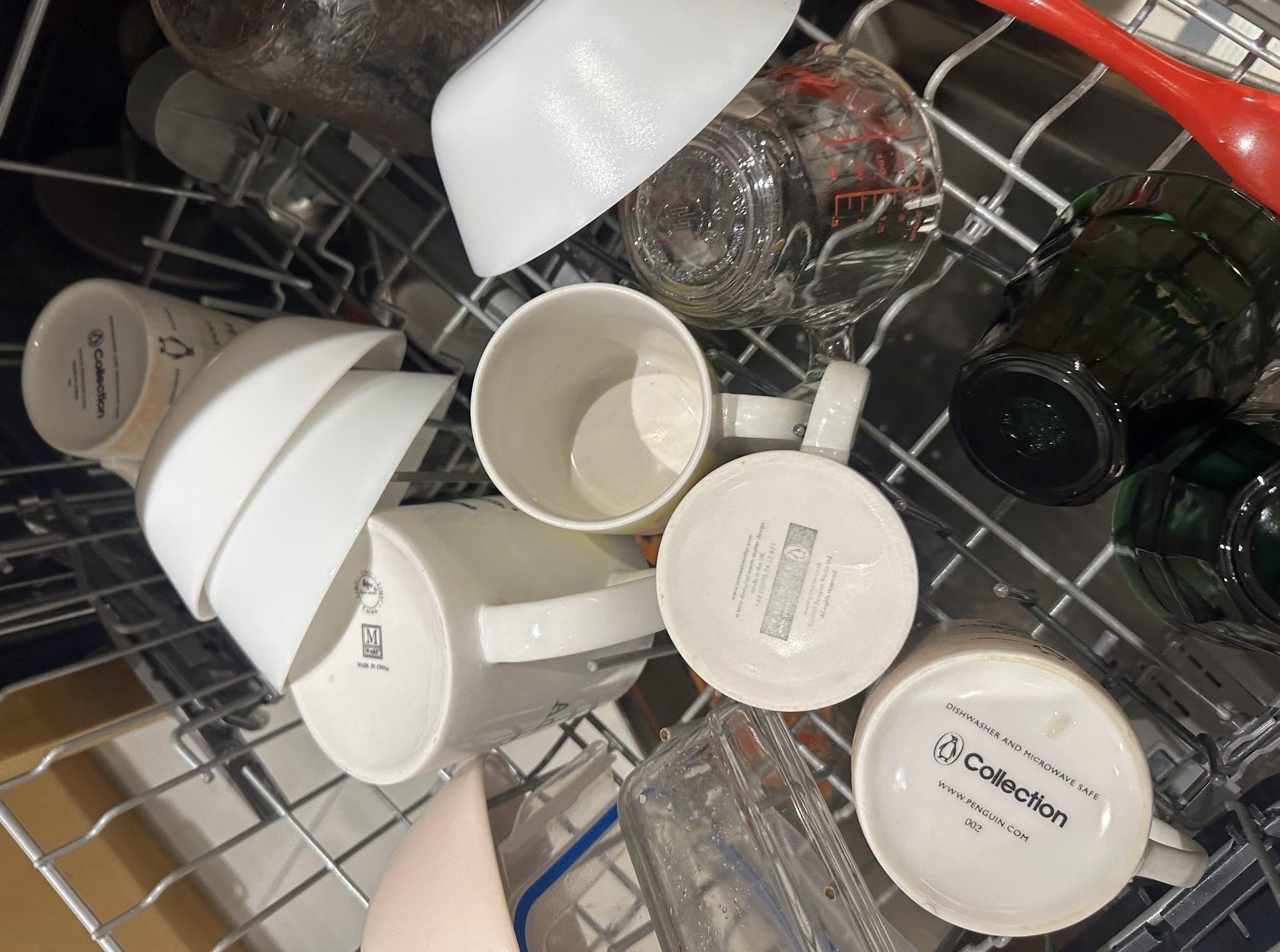
All of which is humane and useful and wise … at least until you slide open the top rack and see this:

“Freud is all nonsense; the secret of neurosis is to be found in the family battle of wills to see who can refuse the longest to help with the dishes.”
— Julian Mitchell
It occurs to me with a shudder that some of my readers might not see the issue with the above picture. Never having examined the workings of the dishwasher, these delightful Raccoons might assume the mugs can be positioned any which way for optimal results. Why, some of those readers may even live in my house! Value pluralism, I say through gritted teeth. Value pluralism! I scream it like Frank Costanza screaming “Serenity now!” And for next week?

Approximately each month, my paid subscribers and I partyishly exchange some of the best things we’ve read, seen, heard, and experienced in a special issue called Get Wit Picks. This week, one of those random synchronicities that happens while grazing through enough interesting material. First, this exchange from Alan Hollinghurst’s The Swimming-Pool Library:
‘Do you live in London all the time?’ I asked him partyishly.
He thought about this: ‘I do, though I’m often elsewhere – in my thoughts. At my age it doesn’t matter where you live. Passent les jours, passent les semaines, as the Frenchman said. I blank a lot, you know. Do you blank?’
‘You mean, just let your mind go blank? Yes, I suppose I do. Or at least, I like letting my mind wander.’
‘There you are. You see, I’ve had such an interesting life and now it’s so bloody dull and everyone’s dead and I can’t remember what I’m saying and all that sort of thing.’ He seemed to lose his thread.
And then this eternally great bit from a 2016 GQ interview with Matt Damon:
Julia Stiles: After The Bourne Ultimatum came out, there was a premiere in London. Prince actually came to it, then got tickets for the cast to come see him [perform]. We were summoned into a room to meet him [after the show]. Matt said, “So you live in Minnesota? I hear you live in Minnesota.”
Matt Damon: Prince said, “I live inside my own heart, Matt Damon.”
Where, pray tell, do you live? Me, I’m in the dishwasher, checking for flaws.

Get Wit Quick No. 382 is top-rack safe. The Zen master Thich Nhat Hanh teaches that washing the dishes can be a regular exercise in mindfulness, a way to connect with your ancestors and see the galaxy in a spoon. I love that for anyone who can achieve it; just don’t forget to clean out the filter from time to time. The mascot of this newsletter is Magnus the magpie, named after the magician from the Deptford Trilogy. The title font is Vulf Sans, the official typeface of the band Vulfpeck. The inferior-for-now and still free AI replicant is at getwitquicker.replit.app. The book was Elements of Wit: Mastering The Art of Being Interesting. I find the express cycle never really works. Tap the ❤️ below for Extra Shine.
Dear Benjamin,
Great piece!
This is one of my favorite quotes on this subject (or any):
“Everybody wants to save the earth; nobody wants to help Mom do the dishes.”
— P.J. O’Rourke
Thank you for sharing as always!
Love
Myq
As I opened this I realized that I am probably in a distinct minority, in that most of my life I have not had (or if I had one used) a dishwasher. First home was an attic in an old Victorian. Then various small apartments, some with dishwasher some without, but seldom used. Then for the past 30 years in a home with a dishwasher we never used and finally got rid of in order to have more cabinet space. My husband and I have always rather enjoyed doing the dishes together and chatting. But now that I think about it, he likes to get all the dishes on the counter organized before he starts washing. I don't really care....so I suppose he probably would have been the tidier and me the raccoon!