

The Wit’s Guide to Bicycles
Or, I am not hurt
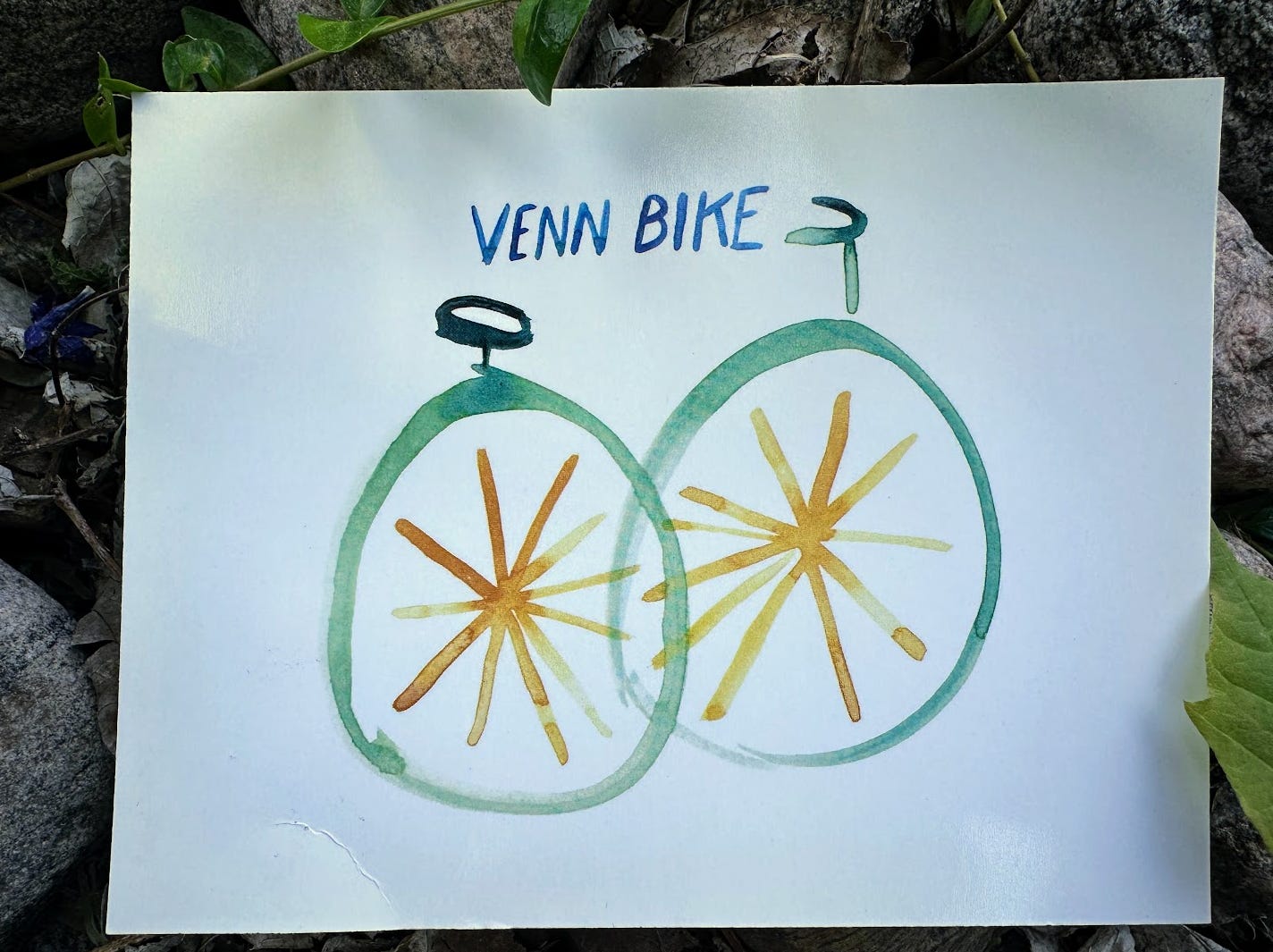
Are things getting better or are they getting worse? Consider this question from behind the handlebars of a bicycle. The philosopher Ivan Illich, whomst even casual readers will remember from GWQ No. 284 (“Merrymaking, or, not trivial to be convivial”), held up the bicycle as one of his Tools for Conviviality, those devices that increase our autonomy and creativity rather than reducing it. Everything that followed the bicycle, namely the Dodge Challenger, went in reverse. So, worse?
“When man invented the bicycle he reached the peak of his attainments. Here was a machine of precision and balance for the convenience of man. And, unlike subsequent inventions for man’s convenience, the more he used it, the fitter his body became. Here, for once, was a product of man’s brain that was entirely beneficial to those who used it, and of no harm or irritation to others. Progress should have stopped when man invented the bicycle.”
— Elizabeth West
By that reading, the 1880s were the pinnacle of civilization, which will be cold comfort to anyone in need of penicillin, insulin, or Fruit by the Foot (though those last two cancel each other out.) Imagine an era when something as simple and astonishing as the bicycle was just invented? It meant that the luminaries of the Victorian era had to learn to ride as adults.
“I think the most ridiculous sight in the world is a man on a bicycle, working away with his feet as hard as he possibly can, and believing that his horse is carrying him instead of, as anyone can see, he carrying the horse.”
— George Bernard Shaw
Shaw was an avidly atrocious cyclist. In the words of his biographer Michael Holroyd: “Many of his falls, from which he would prance away crying ‘I am not hurt,’ with black eyes, violet lips and a red face, acted as trials for his optimism.” In the most literal collision of great minds ever recorded, Shaw went on a bike ride with Bertrand Russell and smashed directly into his fellow philosopher. Shaw was thrown 20 feet from the collision but sustained no injuries. Russell’s bike was totaled and, Shaw gleefully reported, “his knickerbockers were demolished.” Russell had to take a slow train home, and at every stop Shaw was waiting at the station to jeer him. As Russell later recalled, “I suspect that he regarded the whole incident as proof of the virtues of vegetarianism.” Their friendship never recovered.
“Get a bicycle. You will not regret it, if you live.”
— Mark Twain
Other famous bearded men of the era had similar experiences. Leo Tolstoy began to ride at the age of 67 and decided that the exercise was “a form of natural idiocy, that I don’t care what people think, that it is sinless and fun in a childlike way.” Though he passed his cycling test and got a license from the Moscow authorities, the Russian author’s journeys were not without incident.
“If I imagine an obstacle, I feel an insurmountable pull toward it, until a collision happens,” Tolstoy wrote to his daughter. “This is especially true regarding one fat woman, who is, like me, learning to ride the bike. She has a hat with feathers, and as soon as I look at them trembling in the wind, I feel my bike being pulled toward her. The woman yelps and tries to flee, but there is no use. If I don’t dismount from the bicycle in time, I end up hitting her. This happened several times.”
“I can think of no sincere, decent human being, male or female, young or old, saintly or sinful, who can resist the bicycle.”
— William Saroyan
But it’s not just men who like bicycles! Fish also need them. Oh wait, the line “a woman needs a man like a fish needs a bicycle” is empirically true and remarkable in its origins. Often credited to Gloria Steinem, it’s been credibly sourced to an Australian activist named Irina Dunn, who scrawled it on two washroom walls in 1970. It was mentioned in the Sydney Morning Herald in 1975 and started showing up on posters in feminist bookstores around the world soon after. Which goes to show that the right phrase at the right time, even if unveiled next to a toilet that flushes the wrong way round, can travel the world.
“Marriage is a wonderful invention, but then so is a bicycle repair kit.”
— Billy Connolly
The main problem with bicycles, as set out by Flann O’Brien in his cult novel The Third Policeman, is that too much riding of them turns you into one. Come again? Yes, it’s just simple atomic theory. As Sergeant Pluck explains, “people who spent most of their natural lives riding iron bicycles over the rocky roadsteads of this parish get their personalities mixed up with the personalities of their bicycle as a result of the interchanging of the atoms of each of them and you would be surprised at the number of people in these parts who are nearly half people and half bicycles.” The sad result is a lot of leaning against walls, discomfort indoors, and circular leg movements.
“When the spirits are low, when the day appears dark, when work becomes monotonous, when hopes seem hardly worth having, just mount a bicycle and go for a good spin down the road, without thought of anything but the ride you are taking.”
— Arthur Conan Doyle
But are things getting better or worse? One vital data point in this vale of postmodern tears: Every major city now has a bike share program, allowing anyone with a phone and a few dollars to take their life in their handlebars and just go. Whizzing down a quiet leafy street on a humid summer night is one of the best feelings there is, and it’s now available pretty much anywhere. That’s better! Until you crash into the woman in the feathered hat, at which point things get worse.

“Dear bicycle, I shall not call you bike, you were green like so many of your generation, I do not know why.”
— Samuel Beckett
Just as bike is short for bicycle, Mike isn’t short for Micycle. Next week?

Each month my paid subscribers and I exchange some of the best things we’ve read, seen, heard, and experienced in a special issue called Get Wit Picks. This week, a new word that’s suddenly everywhere:
Choppelganger, n. A less attractive version of something or someone. Portmanteau of chopped (teenage slang for ugly) and doppelganger.
First Ilana Weitzman told Sarah Lazarovic about it at Toronto Climate Week, then Ingrid shared it with Fashion Club, and now I’m telling you: Three mentions make it a trend, by the hallowed rules of lifestyle journalism. But Get Wit Quick doesn’t stop there. I went the extra step and asked an actual teenager about this neologism. After the obligatory eyeroll, I was told that of course she’s heard it but no one actually says it. Instead, her friends will call people laide, from the French meaning ugly but also “spiritually wicked.” Much better, because even the glowiest glow up can’t hide moral rot.

Get Wit Quick No. 373 must here call out Get Wit Quick No. 1, which covered the important question of what you ought to yell at a unicyclist. The answer in July 2019 is the answer now: Nothing at all. As Beckett said, every word hollered at a cycle of any sort is a stain on silence. But imagine if we’d kept calling them velocipedes? The mascot of this newsletter is Magnus the magpie, named after the magician from the Deptford Trilogy. The title font is Vulf Sans, the official typeface of the band Vulfpeck. The inferior-for-now and still free AI replicant is at getwitquicker.replit.app. The book was Elements of Wit: Mastering The Art of Being Interesting, which can prop up a kickstand. Tap the ❤️ below to avoid flat tires.
Alas, this reader went down the rabbit hole of " it's not the fall that hurts, it's the landing " ( from your bicycle stories ).
The earliest match to this quip was from 1853 within an anecdote published in “The Ladies’ Repository” magazine of New York.
"After a late supper, and two or three extra glasses, Charlie Bates is apt to be somnambulistic (ed. - sleepwalking ). Night before last, being an occasion of this kind, he backed himself out of his chamber window and fell to the pavement, a distance of ten or twelve feet. A passer-by came up to condole with him, remarking, “You seem to have had a bad fall.” “My dear sir,” answered Charlie, “the fall was a trifle not worth mentioning; but the sudden stop was decidedly unpleasant.”
3500 BCE wheel invented
1817 bicycle invented
Next big leap in wheel technology coming in the year 5300