

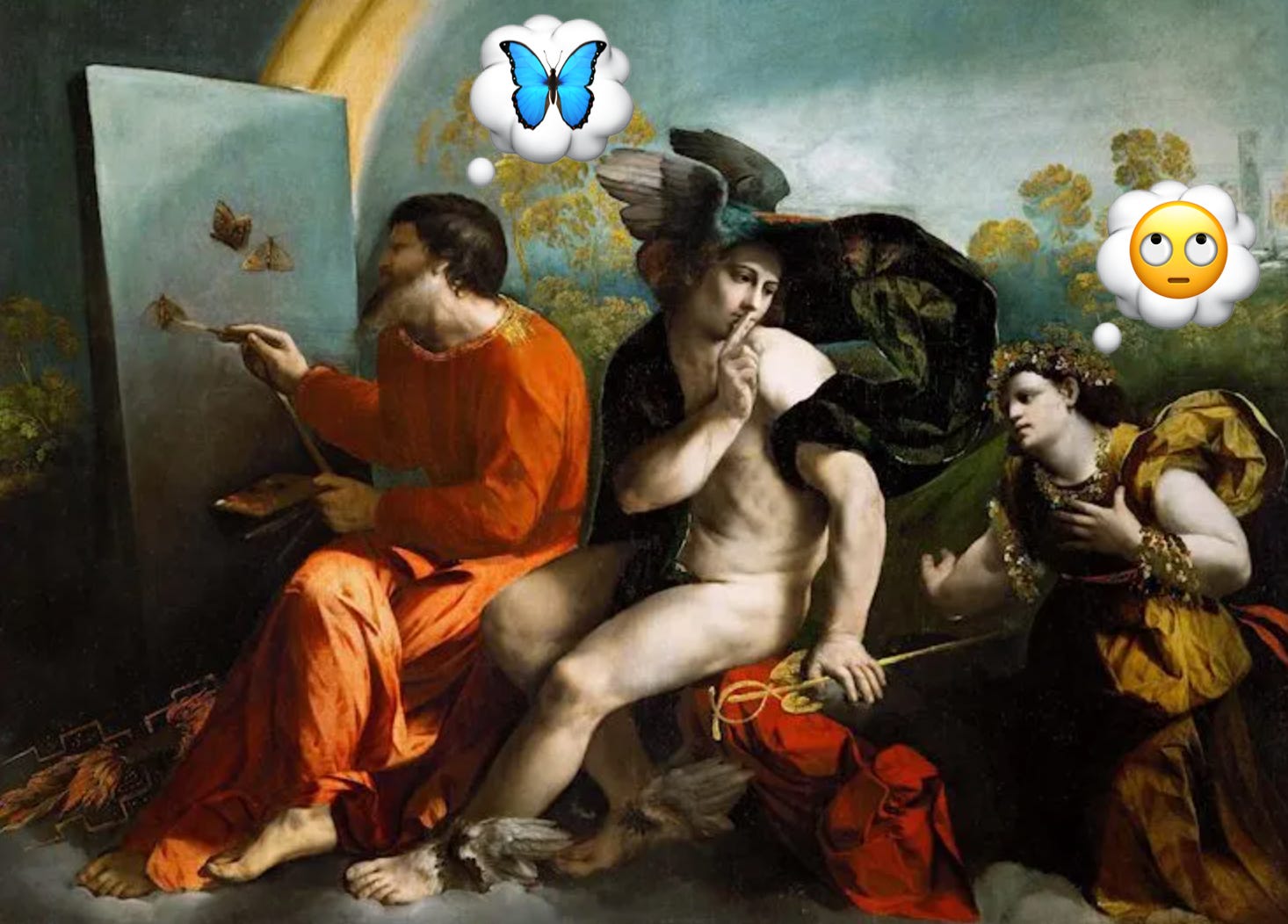
Are you sitting down? Good, because they’ve turned whimsy into an adjective now. By they I of course mean the “they” in “that’s what they say,” which in turn means internet people earnestly explaining “how to dress whimsy” or “whimsy things I love.” The kids are into whimsy, it’s said, because they’re sick of optimization, despair, and grammar.
“Those who shun the whimsy of things will experience rigor mortis before death.”
— Tom Robbins
Whimsy, in its current meaning of playful or spontaneous or simply wearing bright colours, is a near-lock for Word of the Year. This inevitability has an algorithmic dullness to it that is the opposite of whimsical. The YouTuber Ash Callaghan does a great job breaking down what she calls The Whimsy Paradox. “Whimsy now, rather than being defined by playful spontaneity and childlike imagination, is turned into a set of repeatable visual cues,” she explains. “And paradoxically, what was once characterized by unpredictability becomes recognizable through repetition.”
“I never saw a Purple Cow,
I never hope to see one;
But I can tell you anyhow,
I’d rather see than be one.”
— Gelett Burgess
My longstanding discomfort with whimsy is that I almost love it, save for the fact that I don’t like it at all. It’s a phenomenon that lands somewhere between the idea of the uncanny valley and the Sloan lyric “It’s not the band I hate, it’s the fans.” It’s precious. It’s the distance between cute and cutesy. It’s Justin Trudeau’s colourful socks. It’s the Google Doodle. It’s work that pretends to be play.
“Ah yes! I wrote ‘The Purple Cow’ —
I’m Sorry, now, I Wrote it!
But I can Tell You, Anyhow,
I’ll Kill you if you Quote it!”
— Gelett Burgess
So I was primed for James Marriott’s recent screed on the evils of whimsy, specifically the British variety that gave us Count Binface, the masked intergalactic novelty who recently contested a by-election. “A nation that can’t be taken seriously shows itself superior to the world by laughing at it,” he wrote in the Times of London. “Worse, our national humour is increasingly laced with an unconvincing strain of smugness.” Here let me be convincingly and Canadianly smug about Angine de Poitrine, our masked intergalactic novelty that’s a much better joke precisely because they aren’t one.
“His mind is concrete and fastidious,
His nose is remarkably big,
His visage is more or less hideous,
His beard it resembles a wig.”
— Edward Lear
Marriott writes that he was inspired by Kingsley Amis’s intense hatred of whimsy in the work of nonsense poet Edward Lear, because Lear’s lines “conjure up a vision of innumerable wool-clad, amber-beaded aunts and cousins all squealing, ‘Oh I say darling how perfectly super and spiffing and side-splitting!’ It is against that that we are fighting.” In a slantways fashion, yes. Whimsy disintegrates under scrutiny and cannot be bred in captivity. Let it run free! As long as it doesn’t run twee.

“No man is exempt from saying silly things; the misfortune is to say them deliberately.”
— Michel de Montaigne
Why am I so hard on whimsy? Don’t I like fairy lights and googly eyes? Well, I did until I thought about them just now. And for next week?

Approximately each month, my paid subscribers and I exchange some of the best things we’ve read, seen, heard, and experienced in a special issue called Get Wit Picks. This week, a suitably themed line from the excellent September issue of Harper’s, probably my favourite magazine at the moment:
“They behave ‘like the mythical oozlum bird flying in ever smaller circles until it has no place to go but up its own ass.’”
This from Jon Else’s book Frenchman Flat: The Rise and Fall of Atomic Bombs, explaining how the people who make nuclear weapons invariably think “that to ensure global peace they must make bombs that must never be used, all the while somehow demonstrating a willingness to use them.” That’s how I feel about polka-dot socks.

Get Wit Quick No. 384 essentially argues that wit and whimsy are opposites. The mascot of this newsletter isn’t the Oozlum bird, at least not yet. It’s Magnus the magpie, named after the magician from the Deptford Trilogy. The title font is Vulf Sans, the official typeface of the band Vulfpeck. The inferior-for-now and still free AI replicant is at getwitquicker.replit.app. The book was Elements of Wit: Mastering The Art of Being Interesting. It’d be soooo whimsy if you’d tap the ❤️ below.
No longer a fashionable read, Dorothy L Sayers wrote a series of detective novels and short stories whose protagonist is Lord Peter Wimsey ( without the h). He is quite the polymath, whose talents include, apart from criminology, considerable intelligence and athletic ability, collecting incunabula (books from the earliest days of printing). He is an experienced church bell-ringer. He is an expert on matters of food (and especially wine), male fashion, and classical music. He excels at the piano, including Bach's works for keyboard instruments. Lord Peter likes driving fast.
Would he be considered whimsical today or am elitist toff?
Dear Benjamin,
Great piece as always! My fave from this week:
“Those who shun the whimsy of things will experience rigor mortis before death.”
— Tom Robbins
And I love this one as well:
“No man is exempt from saying silly things; the misfortune is to say them deliberately.”
— Michel de Montaigne
Though I'm not sure for whom it is misfortunate!
Thank you for sharing!
Love
Myq