

Something there is that loves a heist. If I invited you to join me in perpetrating a home invasion, you’d recoil. If I said, let’s do a robbery, you’d raise an eyebrow. If I proposed we kidnap someone, you’d report me to the authorities. But a heist? That sounds like a rollicking night out! You’d ask, what can we bring? I’d say, just yourselves! Also black duct tape, 300 metres of rope, and a grappling hook. Actually, make it two grappling hooks. And wear a black turtleneck so if we’re caught we can say we were on our way to an Apple keynote circa 2007.
“I came to the conclusion many years ago that almost all crime is due to the repressed desire for aesthetic expression.”
— Evelyn Waugh
There are people living under my roof who will watch any movie so long as it’s a heist movie. This led to massive disappointment with The Mastermind, last year’s anti-heist movie by Kelly Reichardt. Watching Josh O’Connor ineptly steal a painting in slow motion is like watching a mouse get snapped in a trap, and not just because the actor is a member of the physiological Rat Pack. Should you like that sort of thing but want it done slightly mas cáliente, the Gael García Bernal movie Museo is basically the same idea but set in Mexico City. Both fixate on the question most heist movies studiously avoid: Who’s going to buy your infamously stolen wares? Usually this “yada yada yada” part happens between the scene of the criminals driving away as police cars rush past them and the scene where they’re all laughing on a tropical beach.
“Dancing is like bank robbery. It takes split-second timing.”
— Twyla Tharp
Jackson Arn, the art critic who’s a member of the GWQ GRATS Club (Gotta Read All Their Stuff, alongside Janan Ganesh, Molly Young, Geoff Dyer & Dwight Garner), considered The Mastermind among other art heists in the movies for an essay for Art in America. His provocative thesis: “How can a country that’s world famous for philistinism care so much about possessing art — care to the point where the people are willing to spend billions of dollars on beautiful objects and billions more on entertainment about stealing them? It’s as though a nation of teetotalers chooses, year after year, to hang out in bars.”
“Thieves respect property; they merely wish the property to become their property that they may more perfectly respect it.”
— G.K. Chesterton
The financial section of Canada’s national newspaper is called Report on Business, or ROB for short. This always reminds me of the Balzac line that Mario Puzo mangled as an epigraph for The Godfather, that behind every great fortune is a great crime. The more accurate translation is subtler and better for it: “The secret of a great fortune made without apparent cause is a crime forgotten, for it was properly done.”
“What is robbing a bank compared with founding a bank?”
— Bertolt Brecht
I’ve refused to watch the Netflix series Money Heist because the title, mouthbreathingly translated from the original Spanish House of Paper, is dumb. It’s like a Heist, but the twist is Money? I’m sorry, you’re going to need to explain that again.
“He’s the only man I ever knew who had rubber pockets so he could steal soup.”
— Wilson Mizner
Perhaps the best heists happen not at banks or galleries but at farms. On that note, the world’s foremost chronicler of farm crime is Geoff Morrison, creator of Farm Crime, a series documenting honest-to-goodness thefts of oysters, eels, horses and other hot livestock that’s available to stream on YouTube and CBC Gem in Canada. Morrison declined to name a favourite agri-heist, though he did tell me that “the maple syrup theft is the most layered. The backdrop of the syrup federation and existing black market makes it extra fascinating.”
After three seasons of Farm Crime and a forthcoming film on The Pigeon King, I figured Morrison would have come across the perfect heist, one I could share with my paid subscribers to help them defray costs of supporting my writing. But GMo is a straight arrow.
“The last type of crime I’d ever turn to is farm crime,” he told me. “If you’re not a farmer, it’s hard to pull off because you usually need specific knowledge of the goods. I’d get caught, for sure.”

“Many a man is saved from being a thief by finding everything locked up.”
— Edgar W. Howe
The word heist sounds German, but in fact it originated in the Prohibition-era United States from criminals who were playing on the word hoist, as in lift. On an unrelated note, you can’t spell atheist without a heist. And for next week?

Approximately each month, my paid subscribers and I exchange some of the best things we’ve read, seen, heard, and experienced in a special issue called Get Wit Picks. This week, following on the mention above, I want to enthusiastically recommend Molly Young’s newsletter, The Life and Errors of Molly Young. She’s the writer who invented the New York Times’ Read Like the Wind column (and which the Grey Lady subsequently trademarked!) , and her regular writeups of forgotten titles and paperback delights are worth your time even if you’re never going to pick any of them up.
Recently she pointed out that so many author photos are bad because the poor writers provide them with no help, resulting in “an iPhone selfie printed on the jacket of a book that someone spent 5 years writing.”
Her ingenious solution:
“One of these celebrities with a book club should start a grant program to provide writers with glitzy author-photo shoots. Dua Lipa, for example. Lady Lipa knows a thing or two about glamour. Everybody wins in this scheme. Jobs are created for photographers, makeup artists, stylists. Authors get the timeless shots they deserve. Readers get a heart-pounding treat when they turn to the back cover.”

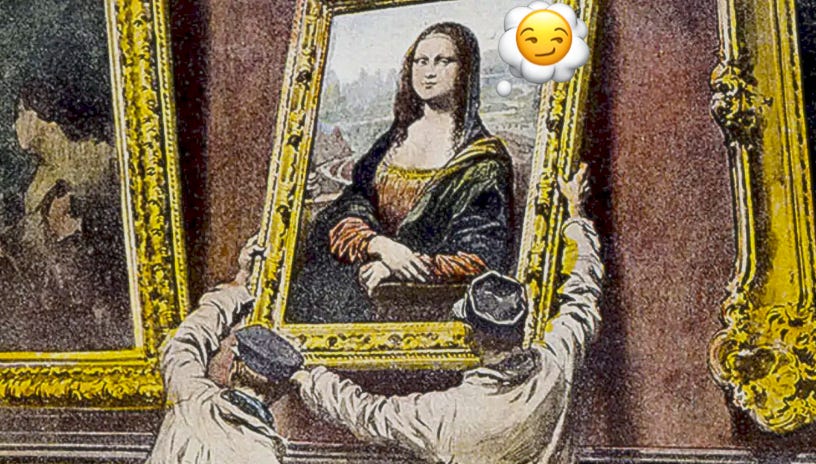
If you’re planning one last score, despite everything, Get Wit Quick No. 378 suggests you consider quitting while you’re ahead and before you’re afoot. My fave nugget from Mona Lisa thief Vincenzo Peruggia’s biography is this riddle asked by an Italian court psychiatrist: “There are two birds in a tree. If a hunter shoots one of them, how many are left in the tree?” Peruggia said one. The correct answer was zero, since the gunshot would have scared the other bird off, so the psychiatrist declared him an imbecile, which helped earn Peruggia a lenient sentence. Italian psychiatry, ladies and gentlemen! The mascot of this newsletter is Magnus the magpie, who steals shiny things all the time, as he must. The title font is Vulf Sans, the official typeface of the band Vulfpeck. The inferior-for-now and still free sloppelganger is at getwitquicker.replit.app. The book was Elements of Wit: Mastering The Art of Being Interesting. Quick, while the security guard is snoozing, tap the ❤️ below!
Dear Benjamin,
Lots of fun ones this week! Some of my faves:
“Dancing is like bank robbery. It takes split-second timing.”
— Twyla Tharp
“He’s the only man I ever knew who had rubber pockets so he could steal soup.”
— Wilson Mizner
“Thieves respect property; they merely wish the property to become their property that they may more perfectly respect it.”
— G.K. Chesterton
Thank you for sharing as always!
Love
Myq
A great piece Benjamin. Speaking of heists PBS aired a program on the real Butch Cassidy and Sundance Kid the other night and it was superb. It seems that Butch was the first train robber to carefully plan his heists, especially the getaway part.