

We think of nostalgia as being sepia toned, but it’s actually the colour of coffee stains. And that’s because coffee shops are never as good as they used to be, and they always have been. The very idea of the café as a third place, beyond home and work, was proposed in 1989 by sociologist Ray Oldenburg because he thought they were going extinct. In fact, he was writing on the cusp of coffee’s second wave, when Starbucks took over the world and all the sitcoms depicted their characters hanging out in trendy cafes.
“I remember one evening sitting with a lot of men in the Coffee House in New York — we had all been drinking, carousing — rather cheap actresses, magazine illustrators, popular painters, popular novelists. A pretty bad lot in general, sold out and all that, but suddenly I found myself saying to myself, ‘These are my people.’”
— Sherwood Anderson
But now that time is gone. Last year, Starbucks was lamenting the loss of its third place status and vowing to reinstate free refills and comfortable seating. And even Dunkin’ Donuts, a coffeehouse only in the most basic sense of the word, has broken free of the beverage required for the verb in their name to make sense. As Sophie Haigney wrote in the The New York Times Magazine, “the drinks on display are increasingly bright pink, electric orange and shades of green that certainly don’t exist in nature.”
“There is a wonderfully dialectical joke in Lubitsch’s Ninotchka. The hero visits a cafeteria and orders coffee without cream, to which the waiter replies: ‘Sorry, but we have run out of cream. Can I bring you coffee without milk?’”
— Slavoj Žižek
You know when coffeehouses were great? In Vienna, between the wars. But because coffee nostalgia is unavoidable, The Guardian’s correspondent reported in 1922 that the scene was dead and all the cafés were closing. “In fact,” wrote Robert Cottrell in The Browser, “a golden age of Viennese café society was about to begin. Karl Kraus, Stefan Zweig and the Vienna Circle were circling the tables. Memo to future journalists: Before pronouncing the end of anything, wait a year.”
“It is the folly of too many to mistake the echo of a London coffeehouse for the voice of the kingdom.”
— Jonathan Swift
Here let me indulge in some personal coffeehouse nostalgia. Twenty years ago, we visited Vienna and toured the coffeehouses, which were still there. I wrote up a little piece for the Weekend Post and Sarah Lazarovic provided watercolour illustrations. Except for the observations about print media, I think it holds up.
“The Café Central lies on the Viennese latitude at the meridian of loneliness. Its inhabitants are, for the most part, people whose hatred of their fellow human beings is as fierce as their longing for people, who want to be alone but need companionship for it.”
— Alfred Polgar
Here it is, reprinted from August 26, 2006:
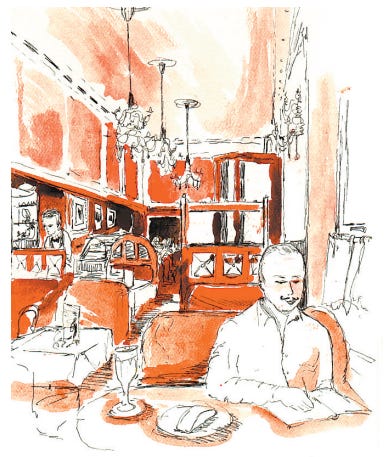
Vienna has given the world psychoanalysis, fascism, the waltz, Zionism, the Lipizzaner stallions and Wiener schnitzel, but if the city’s contributions to human civilization began and ended with the coffee house, it would have been enough. To the uninitiated, a coffee house is a café, but that’s like saying a Big Mac is a proper meal. These are the establishments where Mozart, Freud and Klimt played, wrote and socialized, and where the freelancer can keep office hours. You can have a coffee or a beer, breakfast or dinner, a quick snack or a five-course feast. The Viennese coffee house is the reason the words café and society flow so well together, and the continued existence of this institution is enough to renew your faith in humanity.
First among its charms are the newspapers. The fact that you’re reading this proves you appreciate the medium, so imagine a culture in which coffee houses compete to bring you the widest selection of reading material from around the globe, all free to peruse at your leisure with the purchase of a beverage. Sadly, the National Post has yet to crack the Austrian market, but anglophones can make do with the International Herald Tribune, the Times of London, Daily Telegraph and Financial Times.
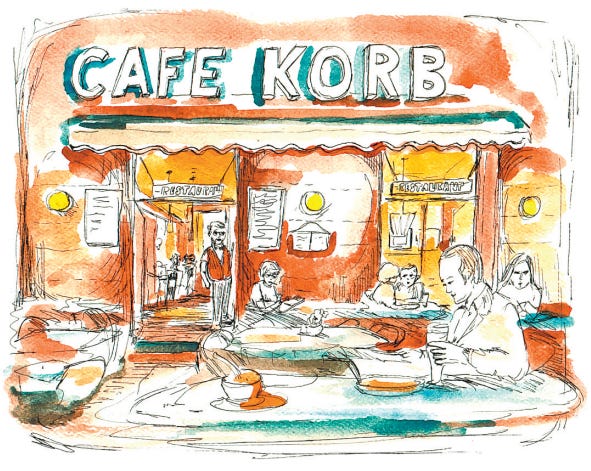
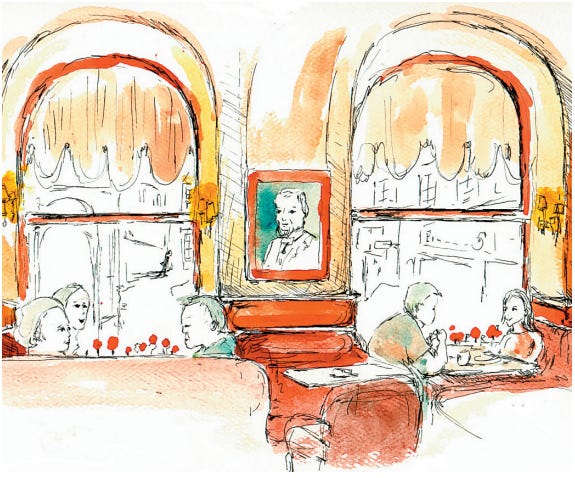
Then there are the buildings themselves, which range from Art Deco marvels to ornate Old World masterpieces to kitschy atomic-age hangouts. The Café Central was designed as a bank in the 1850s, and its arched ceilings and stately interior still feel like a temple of commerce. The Café Korb, on the other hand, has a bowling alley in the basement. Most have an L-shaped floor plan, and they’re all the kind of places you’d like to spend an afternoon in.
They also share similar menus offering all types of Viennese food at all times of the day, the highlights of which are pastries of a uniformly high standard. The apple strudel available at any coffee house in the city presents a convincing argument against the fruit’s consumption without a flaky crust.
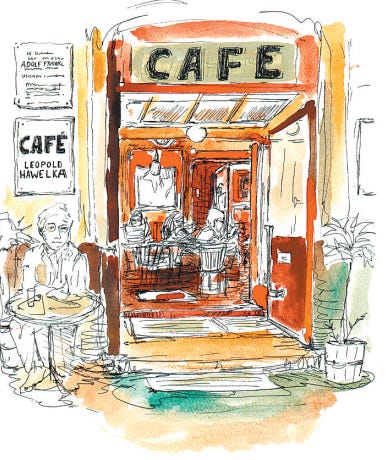
Café Hawelka, the favoured haunt of John Irving in his Vienna days, serves special late-night jam rolls called buchteln, which can only be made properly if it swims in butter during the baking phase. Needless to say, it is outstanding. And if you really don’t feel like dessert, the poppy-seed cake is savoury enough to fool your taste buds. Ask for it by name, if only because it’s fun to order a mohngugelhupf.
The staff who present you with these delicacies aren’t actors between jobs or students paying off their debts: They’re full-time professionals. The tuxedo-clad waiters (and they’re nearly all men) go to school to learn their craft and are dead serious about it. They will never, ever bring you the bill unless you very specifically ask for it (zahlen is the word), and even then they may not deem your stay sufficiently long and relaxing. Even at closing time, late into the night, they will shut down the kitchen, put chairs up on all the tables and collect the day’s papers before they would dream of asking you to settle your bill.
And then there’s the coffee. Served on a silver tray with a glass of water, the many variations require some study before ordering. It’s said that at one coffee house at the turn of the century, an enterprising waiter carried a card of paint samples so customers could order their preferred hue of caffeinated beverage. The mélange, a a mocha or espresso base with steamed milk and foam, is a safe bet to start the day, while the numerous liqueur-enhanced beverages can help you make your own mélange of coffee break and happy hour.
Should you wish to spit in the face of all of this remarkable tradition, there are a couple of Starbucks outlets in the city at which you can get a pomegranate frappuccino in a familiar plastic cup. After bringing decent coffee to Middle America, the Seattle chain’s owners apparently thought that if they could make it in a city that really appreciated its java, they could make it anywhere. In the face of this threat, the coffee houses of Vienna are ready and willing to continue serving butter-drenched pastries and complicated coffees late into the night.

“In Europe the most obstreperous nations are those most addicted to coffee.”
— Robert Lynd
Thank you for indulging that caffeinated reverie. I recently learned of the Historical Cafés Route, a loose association of European coffeehouses of historic significance that has a vague blessing from the eurocrats of Strasbourg. It’s unclear if or how anyone is supposed to travel this route through 15 countries, or how France got short shrift with only one entry (Les Deux Magots, at that) despite giving us the word café, but still, a worthy initiative. And for next week?

Approximately each month, my paid subscribers and I exchange some of the best things we’ve read, seen, heard, and experienced in a special issue called Get Wit Picks. This week, a report from the Stratford Festival, where I had the pleasure of seeing Charlotte Corbeil-Coleman’s The King James Bible Play. As an exploration of translation across eras, the play is a captivating puzzle box of character and connections. As a character in the 1600s says of a mysterious new food called a pineapple: “I like how it bursts out at top — it’s like a good joke told backwards.” It plays in Stratford through the end of the month before moving onto Ottawa’s National Arts Centre in November!

Get Wit Quick No. 386 swims in butter but sinks in margarine. The mascot of this newsletter is Magnus the magpie, named after the magician from the Deptford Trilogy. You know who also thinks he’s a magpie? Jeremy Strong! As he tells GQ: “It’s not about the shininess of the objects, but it’s about their usefulness. The magpie is just trying to build their nest, y’know?” I do! The title font is Vulf Sans, the official typeface of the band Vulfpeck. The inferior-for-now and still free AI replicant is at getwitquicker.replit.app. The book was Elements of Wit: Mastering The Art of Being Interesting. An extra tranche of mohngugelhupf to those who tap the ❤️ below.
As a devotee of cafes I liked this piece a lot. The Vienna cafe review was just as good the second time around, and Sarah’s drawings are still lovely. After this week’s topic, “cake” should be a shoo-in for next week!
I had the good fortune many years ago to enjoy Sacher torte at the Hotel Sacher. Thanks for prompting a lovely recollection